

Since the summer of 2017, the international Catholic community has been wracked by almost constant clergy sexual abuse reports, even finding trusted archbishops and cardinals guilty.
North Carolina dioceses are not exempt from this reckoning, and in December of 2018 the Raleigh diocese released a list of all priests who were reported to be sexually abusive at any point in their priesthood and served in the Raleigh diocese. The Charlotte diocese, however, will hold off until possibly June or later to release their report so that the bishop can “receive additional instruction.” David Hains, the bishop’s spokesperson, insists that the reports produced by the Catholic News Herald are accurate and substantial for now.
Laypeople of Charlotte trust the honesty of the Diocese, the bishops, and their parish priests, but there is no method of guaranteeing that the Diocese has not or will not redact non-prosecuted cases from their published lists so far. Many in the Diocese also agree that having a full list of all priests reported for sexual abuse in the Diocese will “help to understand the [scope] of this issue in our community.”


Transcripts of amended complaint detailing behaviour of the Diocese of Charlotte in a 2009 abuse case.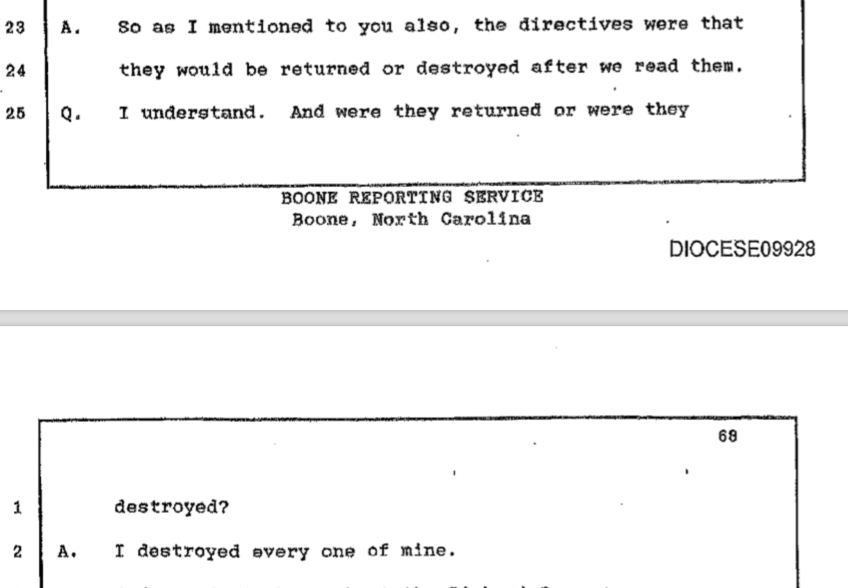
Deposition statement from Monsignor West describing the destruction of reports on the treatment of Damion Lynch, a former Charlotte priest.
According to transcripts of cases against priests in the Charlotte Diocese and lawyers with experience in cases against the Diocese, multiple past executive members of the Charlotte Diocese “destroyed medical reports and records that they received from treatment centers for Diocese priests who’d been accused of sexual misconduct” and “retained an abusive priest even after being warned repeatedly…that the priest was an abuser.” There was also a case in 2000 where Father Kessler and Monsignor West informed an abusive priest that “they won’t allow [accusers] to run at the mouth and put [the priest in question] down” instead of reporting to the Department of Social Services.
This directly contravenes their public policy and Haines’ claims of “reporting every accusation [of child sexual abuse] to the North Carolina Conference of District Attorneys and the North Carolina Department of Social Services.”
Longtime member of the diocese Billy Maddalon concurred, adding “In the case of Monsignor [West’s recent harassment allegations] like a lot of others, it was an open secret for a while. ” While the bishop states that he adhered to “the strict policy of the Diocese of Charlotte to immediately refer all allegations by known accusers of potential sexual misconduct to the Lay Review Board for investigation,” there is no way of knowing if accusations have been made against Monsignor West before this point.
This news especially troubles parents of children attending schools in the Diocese of Charlotte, with one saying, “I trust these priests. I trust that all of them are going to keep my kids safe. I trust them because I have to trust I’m keeping my kids safe, so what other choice do I have?” Seth Langson, a lawyer intimately involved in cases of abuse victims in the Charlotte diocese, clarified that “under current law, [the diocese] doesn’t have to report accusations directly to the police. They only have to report allegations to the District Attorneys and the DSS [Department of Social Services]. This is very different than reporting to the police, where it would [be in public record].”
I trust [parish and school priests] because I have to trust I’m keeping my kids safe, so what other choice do I have?
MACS Parent
In some cases, it was teachers and school administrators who discovered abuse: one notable account describes a youth group leader mistakenly receiving communication between a priest and one of his later accusers. When she reported the inappropriate behaviour to her supervisor, she was assured that “it would be taken care of” and that the supervisor would inform the head parish priest- but the offending priest was never removed from his positions working with children and was allowed to transfer out of the state later that same year.

Damion Lynch, settled 1999 for undisclosed amount due to 1991-95 abuse charges. Left priesthood in 2002. 
Father Joseph Kelleher, arrested and released on bail in 2010 due to abuse charges. 1977 abuse confirmed and other credible accusations are known. Died 2014 with all charges dismissed. 
Father Jeffries Burton, reassigned in 1994 after 1982 abuse allegations discovered. Died 2011 with no criminal or civil suits filed. 
Father Richard Farwell, convicted 2004 to “taking indecent liberties” with a minor in the 1980s with another credible accusation never brought to court. Status as clergy unknown, one of two Charlotte priests to face criminal consequences for sexual abuse. 
Robert Yurgel, convicted 2009 with sexual abuse of a minor in 1999. Only Charlotte priest to serve jail time for sexual abuse. Defrocked 2010.
The men above are the priests that- according to reputable source BishopAccountability.org- have served in the Charlotte diocese, have been either accused of or confessed to sexual abuse of minors, and are still alive or died after 2010. This organization, though, can only cull their evidence from publicly released documents like court reports and news articles. This leaves any allegations left in private diocesan files, like Father Cornell Bradley in the late 1980s and Father Al Gondek in 1993, blind to the public trying to understand the scale of this issue. Again, there is no way of guaranteeing that any informal report released through a Diocesan-controlled source like Catholic News Herald has not redacted accusations in order to make the Diocese look more reliable.
Haines, though, says that “we’ve been…helping the Church deal with this sex abuse scandal for more than fifteen years with…background checks and Protecting God’s Children [a Diocesan educational program focused on spotting signs of child abuse] for every employee and volunteer in the Diocese.” The employees required to attend Protecting God’s Children now includes all seminarians at St. Joseph’s Seminary, confirmed Haines, along with 50,000 clergy and laypeople since 2003.
These efforts, though, do not negate the need for a detailed list of all sex abuse reports, public or private, made against priests who have ever served in the Charlotte Diocese published publicly to the Diocese website. Optimally, this list would be created with independent assistance and with dates of when incidents of abuse occurred and when they were reported to the Diocese. In the future, the Diocese could even track the effectiveness of abuse prevention programs by tracking the implementation of these programs with rates of abuse allegations.
On the topic of the Diocese of Charlotte releasing a full list of credible accusations, a Charlotte Catholic parent commented, “I don’t see any problem with it, and it would really help reassure people that [the Diocese] is really looking out for us. I mean, if you’re not guilty, nothing to fear, right?”
If you or a loved one is suffering sexual abuse, please contact one of these toll-free numbers:
- National Sexual Assault Hotline at 1-800-656-4673
- National Child Abuse Hotline at 1-800-422-4453
- The Trevor Project at 1-866-488-7386
- Darkness to Light at 1-866-367-5444
- Stop It Now at 1-888-773-2362
- The ChildHelp National Abuse Hotline at 1-800-422-4453
- Report to the Charlotte-Mecklenburg Police Department at 311
- Report to the York County Sheriff’s Office at 803-329-1110
- Report to the Chester County Sheriff’s Office at 803-385-5433
- Report to the Lancaster County Sheriff’s Office at 803-283-4136
- If residing in any other county under jurisdiction of the Diocese of Charlotte, please contact your county’s non-emergency number or a nearby lawyer.

 The Cougar Claw